Tiger Sisters Tools
Podcast Episodes Rebuilt as Working Software
Interactive tools built from Tiger Sisters podcast episodes. Each one takes a single episode's framework and attaches input fields to it — the same rules and the same tests, run live against whatever you type. Four tools across two episodes: a LinkedIn About Me builder, an AI onboarding doc builder, a prompt upgrader, and an automation recipe with a readiness gate.
Visit Live Site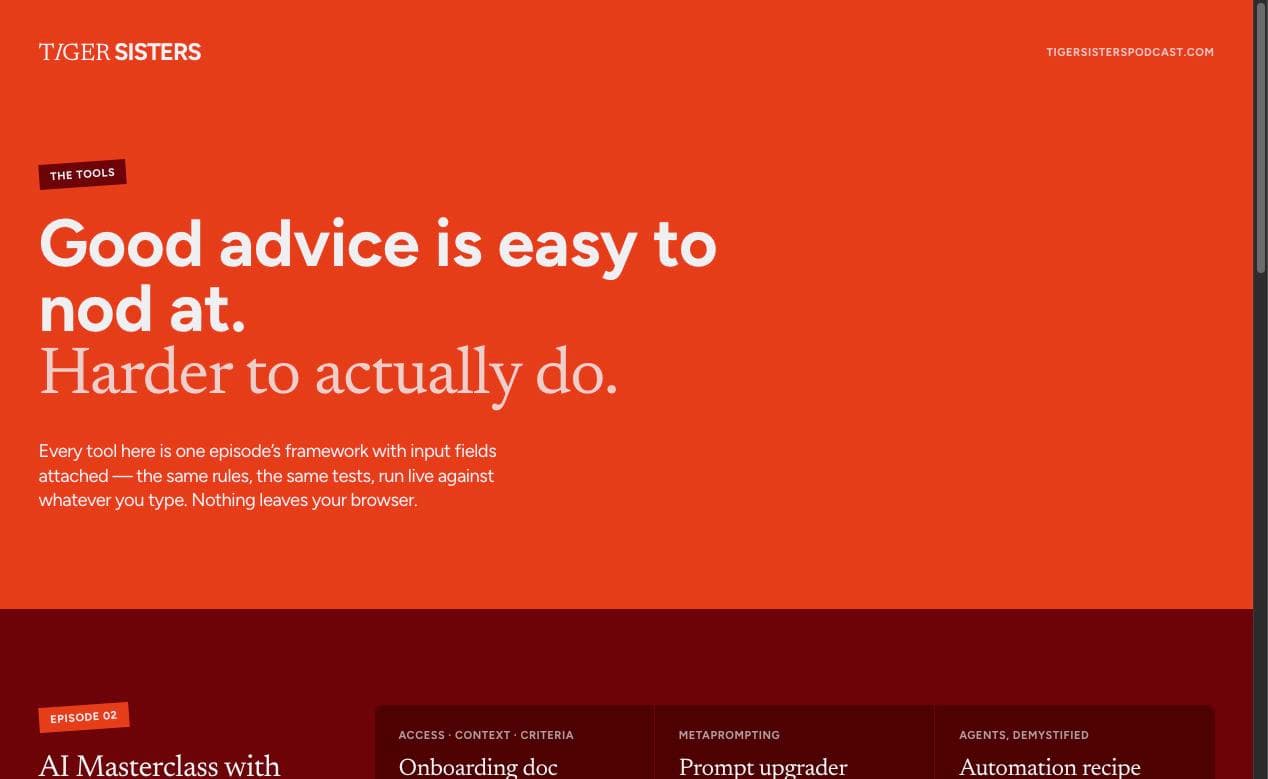
The Problem
Advice content converts poorly into behavior. The gap isn't comprehension, it's application: people understand 'be specific' and still write a generic profile, because in the moment they have no way to tell whether what they just typed is specific. A live meter that scores the actual draft closes that gap in a way a checklist never does.
Research & Discovery
The specificity meter's heuristics come straight from the episode's own worked examples of weak and strong profiles, rather than from generic copywriting advice — which is what makes the score arguable and therefore useful
The About Me preview marks where LinkedIn truncates the section to 'see more', because the practical failure mode isn't a bad profile, it's a good profile whose point lands below the fold
Strategy
Rules, Not Vibes
Every check in the code maps to a written rule in the knowledge docs. Change one, change the other.
Live Scoring
Meters that grade the actual draft and say why, instead of checklists that grade nothing.
Nothing Leaves
localStorage only. No backend, no analytics, no account — appropriate for a tool people type honestly into.
Brand Fidelity
Palette, button mechanics, easing, and the sans-then-serif headline device lifted from the podcast's own site.
Key Decisions
Kept every scoring rule paired to a written knowledge doc, with a table in the README mapping each library to its source. The rules are not free-floating heuristics I invented; they're the episode's argument, made executable
Stored everything in localStorage with no backend and no analytics. These tools ask people to type a draft of how they describe themselves, and the honest version of that is one where nothing is sent anywhere
Made the prompt upgrader diagnose the rough ask itself before applying any technique, so a one-sentence prompt gets caught rather than dressed up
Named the licensed brand faces first in the font stack with close free fallbacks shipped, so the site resolves correctly the moment the licences are added and looks right in the meantime without shipping fonts it has no rights to
Wrote the add-an-episode path into the README as four steps — knowledge doc, episode entry, tool route, catalog entry — so the project grows by convention rather than by archaeology
Results & Impact
4
Interactive Tools
0
Backends or Trackers
100%
Rules Traced to Source
- Built the About Me builder as a three-step flow on Share, Sell, and Search-optimize, with a live specificity meter scoring the draft from 'one of a million' to 'one in a million' on real heuristics — first person, a concrete number, filler-phrase detection, a call to action, a human detail, and length
- Built the onboarding doc builder around the episode's central argument that using an AI tool resembles hiring: three steps for access, day-one context, and success criteria, with a live preview rendered as the markdown file that would sit in the folder the tool reads
- Built the prompt upgrader around six named techniques, with a job picker that resets the toggles to the set that fits and flags any technique that fights the job — asking an unattended automation to interview you, for instance
- Built the automation recipe as a readiness gate rather than a static checklist. It separates blockers from gaps and refuses to say 'ready to schedule' until irreversible-action, human-review, and proven-by-hand criteria are cleared
- Matched the podcast's brand system precisely — the five-colour palette, the button radius with its three rising layers and its tilt on hover, the rotated label chip, the shared easing curve, and the sans-line-then-serif-line headline device