Swob
Swipe-to-Hire Job Matching Platform
Brought on by an ex-colleague to consult for Swob's founders as they prepare for fundraising and enterprise sales. My role: stress-test the product thesis, build functional prototypes that double as investor demos and living specs, and advise on strategy informed by sales calls and investor feedback. The founders have an existing candidate app with traction (10K+ hires, 500+ restaurant locations). I'm helping them expand into the employer side — hiring pipelines, shift management, and multi-source candidate aggregation — so the product story is complete before they raise.
Visit Live Site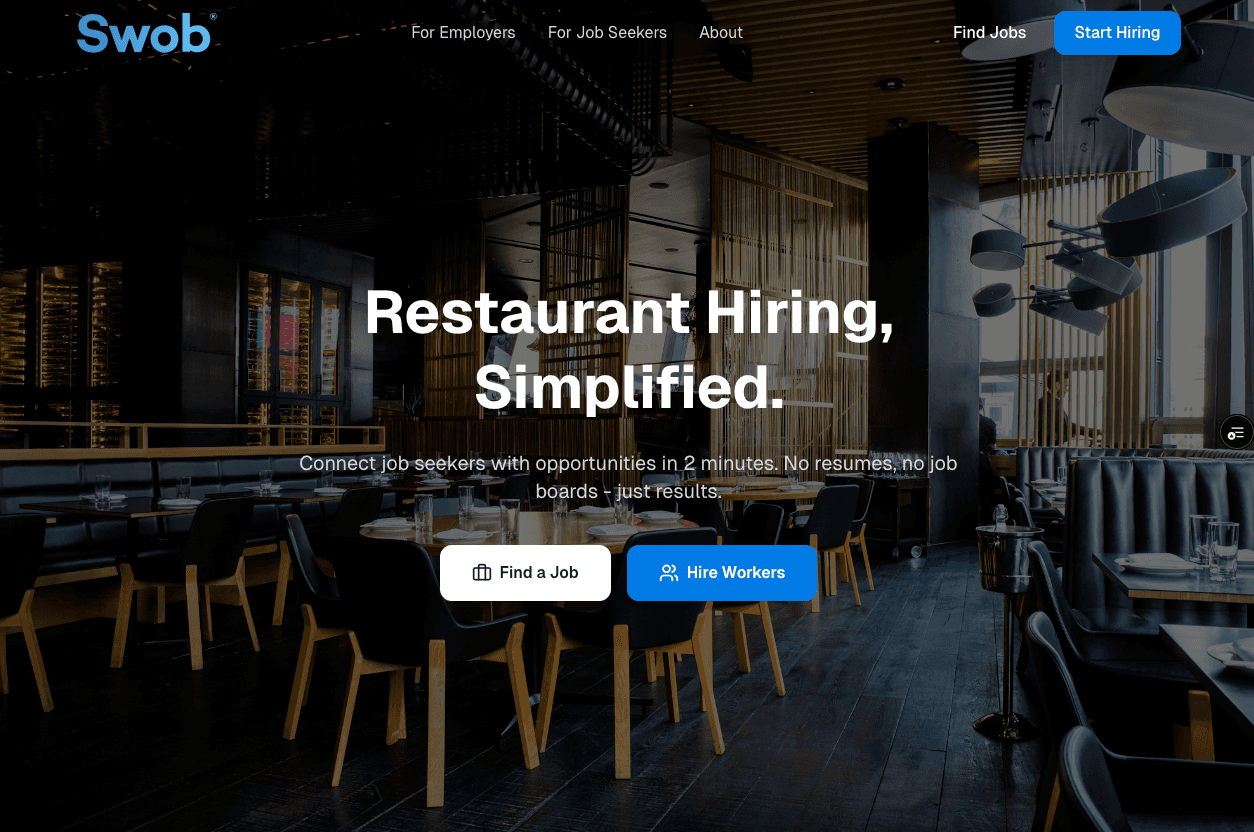


The Problem
Hiring for hourly roles is stuck on platforms built for salaried positions. Managers post on Indeed, wait weeks, and get unqualified applicants. Shift swaps require texting through a staff list. No platform connects who you hire to how you schedule them — and most tools trying to solve this are building for enterprise chains, not the independent restaurants and franchises under 10 locations where Swob competes.
Research & Discovery
Founders' sales calls with restaurant brands revealed the same pattern: post on Indeed, wait 2-3 weeks, get 50+ unqualified applicants, then hire whoever shows up
Managers make hiring decisions in under 30 seconds based on availability, proximity, and vibe — not resumes. Traditional job boards force a workflow that doesn't match how they actually evaluate
Challenged the founders' AI feature assumptions in planning sessions: predictive turnover models need more data than high-turnover restaurants generate, and flagging 'flight risk' employees creates legal exposure. Reframed as targeted automations instead
The #1 scheduling pain point wasn't creating schedules, it was last-minute shift swaps. Managers spent evenings texting through their staff list. Peer-to-peer swap removed them from the loop entirely
Strategy
Target customer: SMB restaurant franchises with under 10 locations — first market entry in Austin, Chicago, and Atlanta. Competitive landscape: Indeed and ZipRecruiter own job posting but stop at the hire. When I Work and Homebase own scheduling but don't touch hiring. No platform connects who you hire to how you schedule them. Go-to-market: Lead with the swipe-to-match hiring tool as a free wedge, the sharpest demo and easiest close. Once a manager hires through Swob, expand into scheduling and shift-swap. The candidate dashboard creates a two-sided network effect. Business model: Free hiring tool, paid scheduling suite with per-location pricing. The prototype suite is designed to close contracts and raise capital simultaneously.
Key Decisions
Split into 5 apps instead of a monolith because each product serves a different persona (manager, candidate, admin) with its own deployment cycle and demo path
Chose swipe UI over traditional list/filter because restaurant managers hire on gut + availability, not keyword matching — validated through founder sales calls
Advised founders to cut the white-label theming system scope after early customers only wanted logo + brand color. Lesson: validate distribution thesis before building premium infrastructure
Recommended building ZipRecruiter integration first over Indeed because Indeed's Partner Program takes months to approve — de-risk the timeline by shipping the faster integration
Results & Impact
- Prototypes directly used in investor meetings and sales conversations with restaurant brands
- PostHog funnel tracking identified a 3x drop-off at onboarding — reduced form fields to email + business name, improving conversion significantly
- Swipe-to-match prototype tested with 3 restaurant managers: average time to shortlist dropped from days to under 2 minutes
- Strategic questioning during planning sessions surfaced legal risks in predictive turnover features and reframed 'AI' features as well-designed automations, saving months of misallocated engineering effort