Health Dashboard
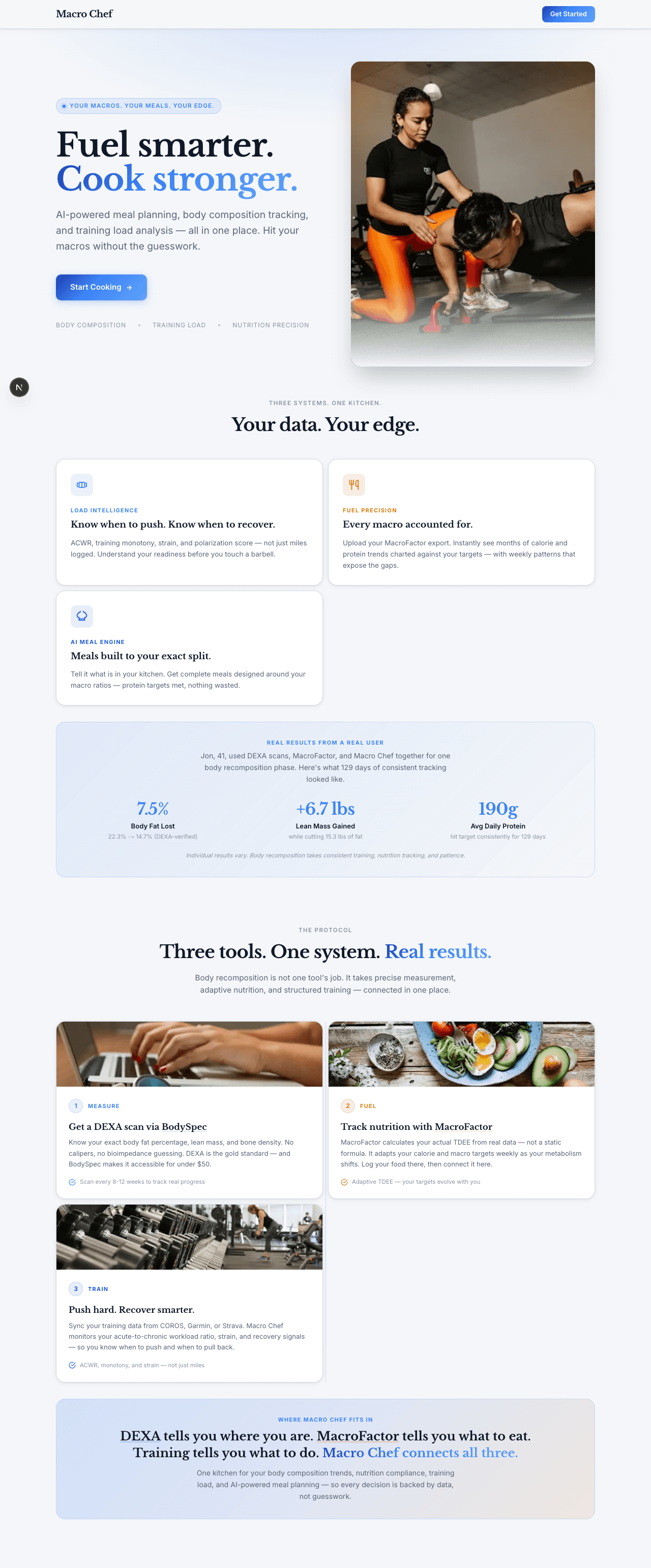
AI-Powered Fitness & Nutrition Analytics
My Role
Built to solve my own problem during a 6-month body recomposition program. Designed the data model, built all integrations (Strava, DEXA, COROS, Claude), and use the dashboard daily. Now testing with members of Everfit Motion, our gym community, to validate whether the same systems that worked for me can help others achieve similar results. The API integration architecture mirrors challenges I faced at Treasure DAO, where I led the launch of a new blockchain on Arbitrum and shipped a gaming NFT marketplace — both required orchestrating multiple third-party APIs and data sources into a coherent product. The analytics dashboard design draws from my experience at Bandai Namco (PAC-MAN franchise, 10M+ weekly installs) and Big Fish Games, where I built analytics pipelines from scratch and used data visualization to drive product decisions.
The Problem
People pursuing body recomposition generate data across 5+ apps with no unified view. Strava doesn't know your body composition. Your DEXA scan doesn't factor into your meal plan. Training load calculations require manual spreadsheets. And the hardest part — knowing what to eat to match your specific fat loss and muscle gain goals — is left entirely to guesswork. The result: people collect data they never act on because synthesizing it takes more effort than the workout itself.
What I Learned from Users
- Dogfooding: Used the dashboard daily throughout my own 6-month body recomposition — every design decision came from hitting my own pain points as a real user
- Talked to members of Everfit Motion (our gym community) — most tracked nutrition in spreadsheets or not at all. The gap wasn't motivation, it was that existing tools (MyFitnessPal, Cronometer) don't connect nutrition to training load and body composition goals
- DEXA scan data was the most valuable and least accessible — everyone I talked to had scans but never looked at the results more than once because the PDFs are dense and clinical. Making that data visual and trackable over time was the breakthrough insight
- The #1 question from gym members was 'What should I eat to hit my goals?' — meal planning matched to specific macro targets and body recomposition phases was the killer feature they couldn't find anywhere else
Why I Built This
After 6 months of weightlifting and body recomposition, I'd found a system that actually worked — fat reduction and muscle increase with measurable results. But the tools were all disconnected. Strava told me my pace, COROS told me my heart rate, my DEXA scan was a PDF I never looked at, and my nutrition tracking was a guess. So I built a platform that married all these systems together. The killer feature is an AI-generated meal planner that matches your specific goals — because nutrition is the hardest part of any body recomposition program and most people give up there. I'm now testing it with our gym community, Everfit Motion, to help others use the same systems I used.
Strategy
Target customer: People pursuing body recomposition — fat reduction and muscle increase — who track data across multiple devices and want actionable insights, not just more charts. Competitive landscape: Strava is social but not analytical. TrainingPeaks has deep analytics but no nutrition or body composition. MyFitnessPal tracks food but is disconnected from training. No product unifies all three. Product thesis: The value isn't in collecting data — it's in connecting data across sources to surface insights no single app can provide. The AI meal planner is the differentiator — nutrition matched to your specific body composition goals is the hardest problem to solve and the one most people give up on. Current status: Testing with Everfit Motion gym community after proving the system on myself with 6 months of results.
What I Built
This project came from my own weightlifting and body recomposition journey. I found a system of fat reduction and muscle increase that helped me get tremendous results in 6 months, and I wanted to help others do the same. Fitness data is scattered across apps that don't talk to each other — Strava tracks your runs, COROS logs your heart rate, a DEXA scan lives in a PDF, and your meals are in a spreadsheet. Health Dashboard pulls it all into one place and makes it actionable, with an AI-generated meal planner that matches your specific goals — one of the hardest things to get right. I'm now testing it within our gym community called Everfit Motion.
Key Decisions & Tradeoffs
- Used Strava webhooks instead of polling — real-time sync with no rate limit issues and instant dashboard updates after a workout
- Built a custom DEXA PDF parser instead of manual entry — scans have a consistent format, so regex extraction is reliable and saves 15 minutes per scan
- Chose Claude over GPT for meal planning because of longer context windows — the prompt includes full macro targets, dietary restrictions, available ingredients, and recent meal history
- Built with Recharts instead of D3 — the charts are standard (line, bar, scatter) and Recharts integrates natively with React, saving weeks of custom SVG work
- Stored everything in Supabase/Postgres instead of a time-series DB — the data volume is personal-scale, and Postgres's JSON columns handle the varied schemas from different devices
Outcomes & Results
- 4 data sources unified into one dashboard — replacing manual spreadsheet tracking entirely
- AI meal planning generating nutritionally-targeted recipes in under 3 seconds via Claude API
- Strava webhooks processing activities in real-time — zero manual data entry after initial setup
- DEXA PDF parser extracting 20+ body composition data points from unstructured scan reports
- Training load dashboard surfacing injury risk indicators (ACWR > 1.5) that were invisible before
What Didn't Work (And What I Changed)
- First version tried to auto-import data from 6 different sources including Apple Health and Garmin. The integration complexity was unsustainable — each API had different auth flows, rate limits, and data formats. Cut to 3 core sources (Strava, DEXA, COROS) that covered 90% of the value with 50% of the effort
- Built an elaborate meal logging UI with barcode scanning and food database search. Never used it — too much friction during a busy training day. Replaced it with a Claude-powered approach: describe what you ate in plain text, and AI extracts the macros. Logging time went from 5 minutes to 30 seconds
- Originally displayed all metrics on a single dashboard page. Information overload made it useless — I couldn't find what I needed quickly. Reorganized into focused views: Training, Nutrition, Body Composition, and a daily summary. Usage went from checking once a week to checking daily
Technical Highlights
- Claude-powered meal planning: generates recipes based on macros, goals, and available ingredients
- Strava webhook integration for real-time activity syncing without manual imports
- DEXA scan PDF parser that extracts body composition data into trackable trends
- COROS .FIT file decoder for heart rate zones, training load, and recovery metrics
- Training load analytics: ACWR ratios, monotony scoring, and polarization analysis
- Body composition dashboard with regional fat distribution and muscle balance tracking
Tech Stack
Products Built
health
Full health analytics dashboard
Want to discuss how I approach product problems like this?
Let's connect