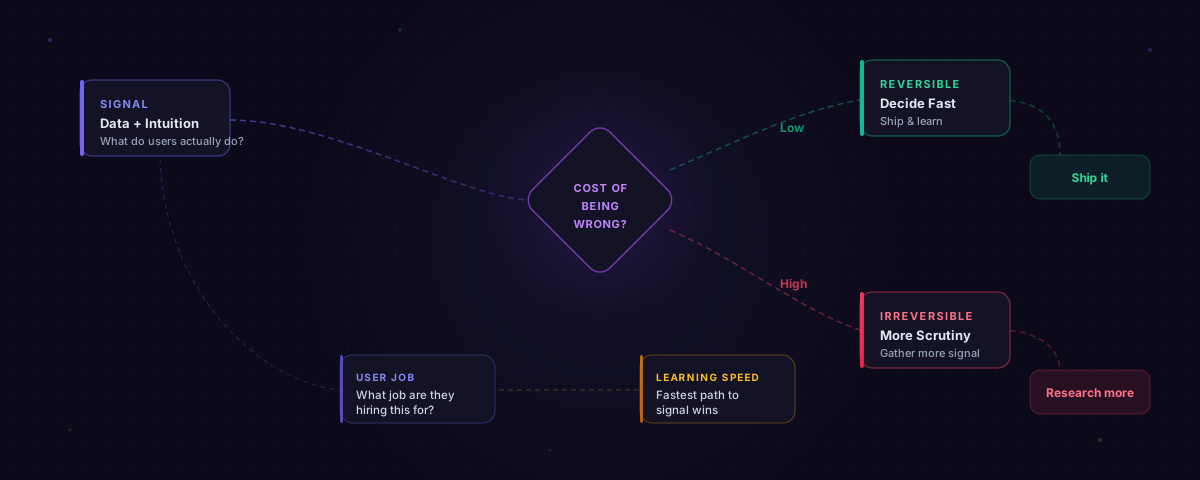
Most product advice boils down to "follow the data." And most of the time, that's right. But the interesting decisions, the ones that actually move a product, happen when the data is ambiguous and you have to make a call with incomplete information. This post is about how I make those calls.
The Pottery Friends Pivot
When I built Pottery Friends, a community platform for pottery studios, I designed the home screen around a social feed. Instagram-style photo sharing. It made sense. Potters love showing their work, and feed-first home screens are the default pattern for community apps.
The data told a different story. PostHog showed that members were landing on the feed and immediately navigating away, to Events. Session recordings confirmed it: tap home, skip feed, tap Events, browse upcoming workshops, done. The feed wasn't broken. Members just didn't care about it as much as I thought they would.
The Framework: Cost of Being Wrong
When I hit a decision like this, I don't ask "what does the data say?" first. I ask: What's the cost of being wrong in each direction?
- If I keep the feed-first design and I'm wrong: Members keep skipping the feed. Engagement stays flat. The app feels like it's not built for them. Churn risk goes up. The cost is slow: death by a thousand sessions where people don't find what they came for.
- If I switch to events-first and I'm wrong: Feed engagement drops. But feed engagement was already low. And if events-first doesn't work, I can always revert. The cost is a sprint of work and a week of monitoring.
The asymmetry was obvious. One direction had a low cost of failure and a high cost of inaction. The other had a high cost of inaction and an easy reversal. This isn't a data question. It's a risk question.
The Decision
I redesigned the home screen around events and workshops. The feed moved to its own tab. I shipped it in a week and watched the numbers.
Engagement doubled. Not because the feed was bad, but because members came to Pottery Friends for a specific job: "What's happening at my studio this week?" The feed served a secondary job, social connection, that mattered, but not as the first thing they saw.
The Broader Framework
Every product decision I make runs through a version of this filter:
1. What's the fastest path to learning something we don't know? If we're debating two approaches and one gives us signal in a week while the other takes a quarter, I'll almost always pick the faster one, even if it's less elegant. Speed of learning beats quality of guessing.
2. What's the cost of being wrong? Reversible decisions get made fast. Irreversible ones (pricing changes, platform migrations, data model changes) get more scrutiny. Most decisions are more reversible than people think.
3. What job is the user actually hiring this product to do? Not the job I designed it for. Not the job the roadmap says. The job they're actually doing when they open the app. I watch session recordings religiously for this reason: the gap between intended use and actual use is where the best product insights live.
4. Discovery and delivery run in parallel, not in sequence. I don't believe in "research phase then build phase." You learn the most by shipping something real to real users. The Pottery Friends feed-to-events pivot only happened because the product was live and generating real behavioral data. A prototype or mockup would have validated the feed-first design because people would have said "yeah, that looks good" in an interview.
Why This Matters
I've seen PMs freeze when the data doesn't give a clean answer. They run another A/B test, schedule another round of interviews, add another week to the research timeline. Sometimes that's right. But often, the cost of not deciding is higher than the cost of deciding wrong.
The best product decisions I've made weren't the ones where I had the most data. They were the ones where I correctly assessed the cost of being wrong, moved fast, and stayed close enough to the outcome to course-correct quickly.
After 15 years and building 4 products from scratch, that's the muscle I trust most: not pattern matching from past experience, but knowing how to make a good decision when the answer isn't obvious.